
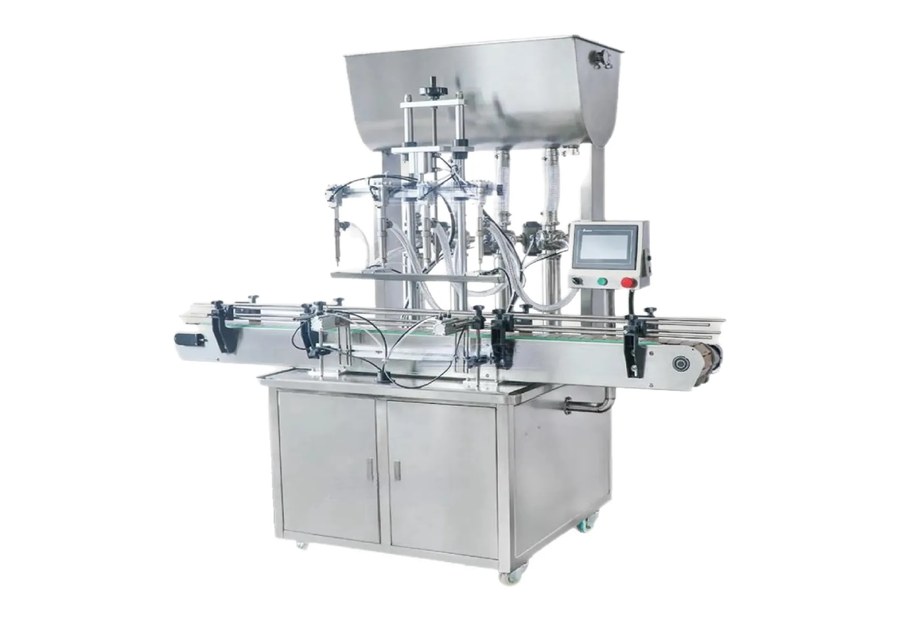
Sauces and condiments
Ketchup, chutney, pesto, mayonnaise, dressings and viscous food sauces where drip control and clean jar presentation matter.
Sauce filling machines →Explain the most common paste filling method in plain production language: product movement, cylinder range, hopper feed, nozzle cut-off and cleanability.
Thicker products often need a controlled volumetric dosing method. Compare piston filling when you need repeatable fills for sauces, creams, gels, honey, pastes or similar viscous products.
A proper specification should cover fill range, cylinder selection, hopper feed, valve and nozzle design, cleaning access, product temperature and changeover. Avoid over-promising: the right answer depends on product testing and sample review.
| Question | Why it matters | What to send |
|---|---|---|
| What is the product? | Viscosity, particles and temperature affect the cylinder, valve and nozzle. | Product name, sample, SDS for chemicals and expected filling temperature. |
| What is the dose? | The cylinder range must match smallest and largest required fill. | Minimum and maximum fill volume plus tolerance target. |
| What container is used? | Neck opening and stability decide nozzle diameter and handling method. | Photos, dimensions, material and container samples. |
| How often do you change SKU? | Changeovers affect cleaning, hopper design and operator workload. | SKU list, cleaning needs and batch size. |
Ketchup, chutney, pesto, mayonnaise, dressings and viscous food sauces where drip control and clean jar presentation matter.
Sauce filling machines →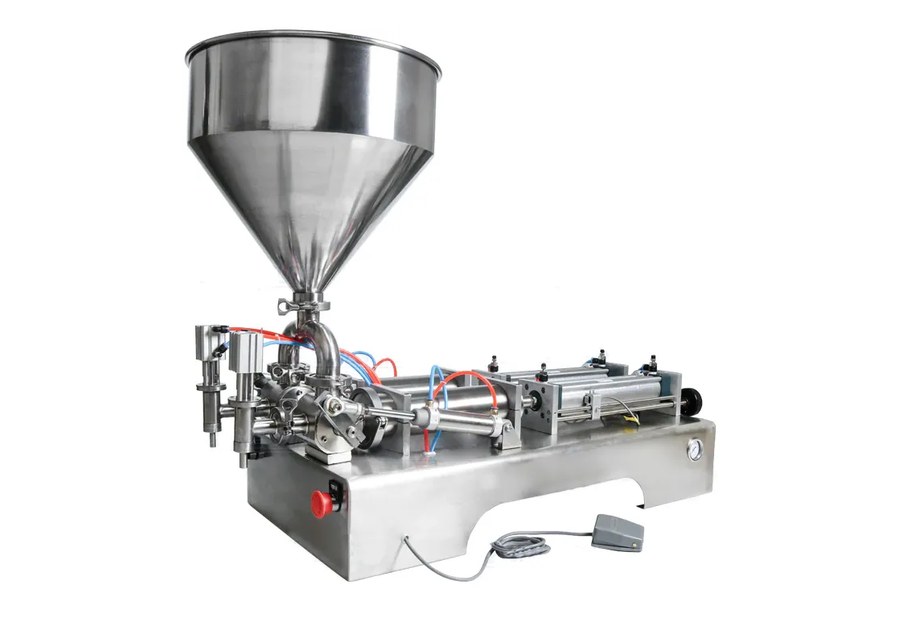
Thick, sticky and temperature-sensitive products that may need heated hoppers, careful cut-off and reliable fill repeatability.
Honey and jam fillers →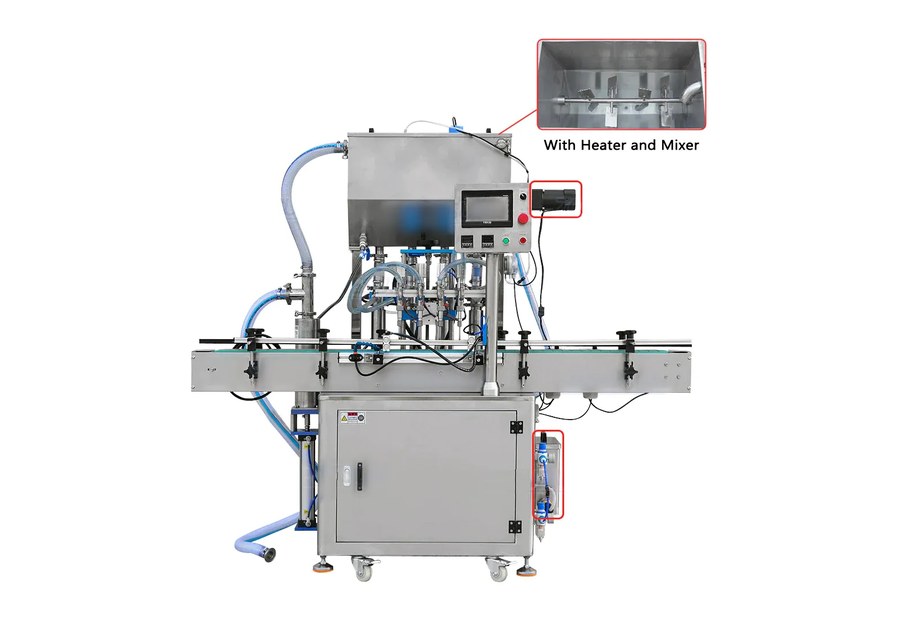
Creams, masks, lotions, gels and personal-care products where cleanability, recipe control and closure integration are important.
Cream and gel filling →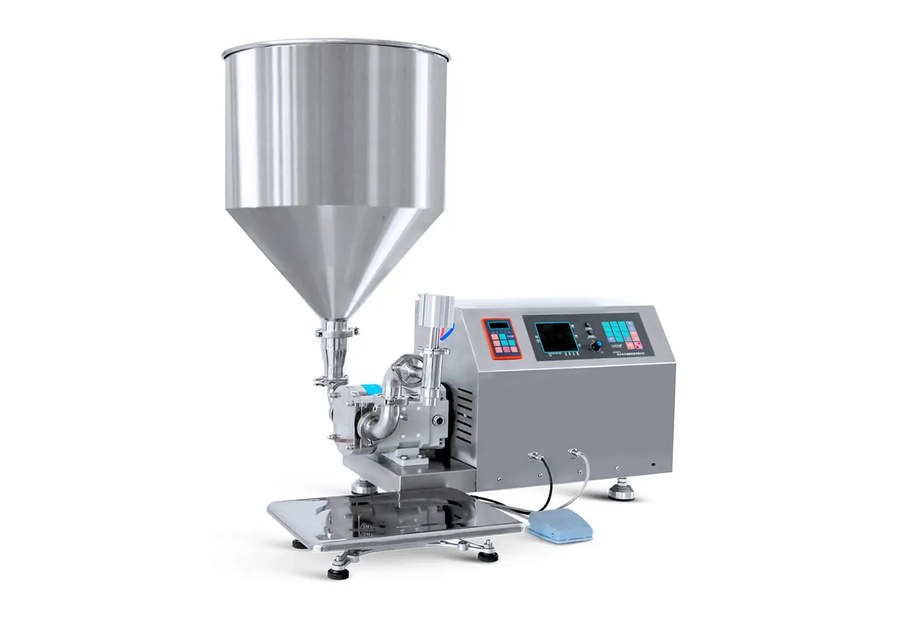
Industrial pastes, waxes, greases, adhesives and sealants where viscosity, stringing and material compatibility must be reviewed.
Industrial paste filling →A piston filler moves a defined volume of product using a positive-displacement action, which makes it useful for many viscous and paste-like products.
They may be suitable for some particulate products, but particle size, suspension, valve design and product path need review before selection.
Fill range, product temperature, air pockets, viscosity, cylinder size, valve design, nozzle cut-off and operator setup can all affect repeatability.
A piston filler draws product into a measured chamber and discharges it into the pack. Repeatable displacement is only useful when the product enters the cylinder consistently, passes the valves without damage or blockage and leaves the nozzle with a controlled cut-off.
Choose the cylinder module around the production dose range. The published Lancing piston ranges use several modules rather than one universal cylinder. Confirm the working stroke for each SKU and how calibration will be checked after a product or cylinder change.
Valve port size and geometry affect how thick or particulate product moves into and out of the cylinder. The largest particle, its shape and concentration should be compared with the narrowest restriction. A product sample trial should check for damage, bridging and inconsistent chamber fill.
Product chemistry, temperature, cleaning agents and abrasive inclusions can affect piston seals, valve seats and hoses. For adhesives or reactive products, define maximum dwell time and shutdown cleaning before specifying materials.
A closing nozzle can stop flow at the tip, while suck-back can draw a small amount of product away from the outlet. The correct arrangement depends on stringing, product elasticity, pressure and neck opening. Too much suck-back can pull air into the path or disturb dose repeatability.
| Failure mode | Likely areas to investigate | Evidence to collect |
|---|---|---|
| Fill quantity drifts | Air in the cylinder, inconsistent hopper feed, seal leakage, product temperature or incomplete valve switching. | Sequential fill checks, product temperature, hopper level and observation of the inlet stroke. |
| Short or intermittent fills | Restricted inlet, particles at a valve, product cavitation or insufficient refill time. | Product sample, particle data, refill timing and inspection of the product path. |
| Drips or strings | Nozzle type, suck-back setting, product pressure, fill profile and product temperature. | Close-up video, time between containers and neck-opening dimensions. |
| Slow cleaning | Excess hold-up, inaccessible valves, unsuitable hose layout or too many product-contact parts. | Strip-down demonstration, residual product quantity and written cleaning sequence. |
For general volumetric principles, see Lancing piston filling machines. Keep this paste-focused route for products where thick flow, hopper feed, particles and nozzle cut-off are central to the design.
Strong candidate for repeatable batch doses when valves and cylinder can handle the product.
Consider rotor-lobe or another positive-displacement pump when continuous product transfer or a different product path is preferable.
Compare positive displacement →Confirm chamber refill, particle passage, dose repeatability and cleaning with representative product.
Plan a product test →The cylinder sets the available displacement range. The selected module should cover the required fills with enough adjustment and repeatability, without relying on one cylinder to operate impractically across every size.
Some can, provided the complete passage is large enough and the valve action does not crush or trap the inclusions. Test the largest credible particles and their normal concentration.
Air can enter through an aerated product, low hopper level, poor inlet feed, excessive suck-back or leakage. Air changes apparent volume and can reduce repeatability.
No. It is one cut-off tool. The nozzle, product pressure, fill profile and product behaviour should be tested together, because excessive suck-back can create other problems.
State the product, temperature, dose, sample count, speed and measurement method. A percentage without those conditions is not enough for acceptance.
A pump route may be preferable when product transfer, particles, continuous feed, shear or cleaning requirements do not suit the selected piston valves and cylinder.
A piston system can displace a repeatable chamber volume only when every stage of the cycle completes. Observing the draw, valve change, discharge and cut-off separately makes troubleshooting more useful than changing several settings at once.
| Cycle stage | What must happen | Evidence to record |
|---|---|---|
| Product draw | The inlet path supplies product without cavitation, excessive restriction or air entering above the hopper outlet. | Hopper level, product temperature, draw time and whether the chamber appears fully charged on consecutive cycles. |
| Chamber condition | The measured volume contains product rather than compressible air, separated liquid or an inconsistent particle distribution. | Sequential fill results, observation of trapped air and comparison between the beginning and end of a batch. |
| Valve transition | The inlet closes and the discharge route opens without trapping inclusions, leaking backwards or delaying the stroke. | Valve timing, sound or movement changes, particle condition and inspection for residue at seats or restrictions. |
| Discharge | The piston completes its intended movement while the product leaves at a controlled rate suited to the container. | Stroke setting, fill profile, product pressure, nozzle position and any splash, foam or container movement. |
| Cut-off and recovery | The nozzle closes cleanly and the system resets without pulling harmful air into the next dose. | Close-up video, time between containers, suck-back setting, first fill after a stop and product remaining at the tip. |
A percentage is only useful when its basis is clear. The production record should allow another operator or acceptance witness to repeat the check with the same product condition and understand whether a change comes from the machine, the product or the measurement.
State whether the target is volume, net mass or another agreed measure. When a volumetric dose is checked by weight, record density assumptions and product temperature.
Identify priming and setup containers separately, then measure consecutive production fills. Random isolated samples can miss startup effects or gradual drift.
Capture cylinder module, stroke or recipe, nozzle, valve arrangement, hopper level, product temperature and any heat, pressure or agitation applied.
Define what happens when a check exceeds the agreed limit: stop, adjust, isolate containers, inspect seals or valves, and verify a new stable sequence before restarting.
The practical SKU range is defined by change parts as well as settings. List the cylinder module, inlet and outlet valve, nozzle bore, seals, hopper or feed connection and container supports required for each product family. Confirm those parts during the sample trial, then retain the setup with the cleaning and restart record. Compare alternative pump routes on the positive-displacement filling page, and use the buyer guide to place the measurement method in the quotation.
Air, incomplete chamber filling, residual rinse liquid, seal wetting, temperature and product settling can affect startup. Separate setup containers from the agreed production sample and define when stable checks begin.
Record the exact container sequence and observe hopper level, inlet refill, valve movement, particles and air. An intermittent restriction or incomplete draw may not be found by averaging many fills together.
The buyer should set a sampling plan suited to the product, process risk and quality system. The machine specification should make the chosen check practical and state which condition requires adjustment or investigation.
No. Confirm whether it is based on target fill or full scale, the product and temperature used, dose, sample count, machine speed and measurement method. Contractual acceptance should use the buyer’s agreed conditions.
A repeatable piston stroke cannot produce a stable dose if the cylinder does not refill consistently or if product remains in the valve and nozzle differently from cycle to cycle. Test at the intended hopper level, product temperature and fill profile.
Where several cylinder modules or change parts cover a wide dose range, confirm the practical operating range for each required SKU rather than assuming one piston size performs equally well at every stroke setting.
A piston can displace a repeatable volume only when the chamber fills consistently and the valves, seals and nozzle behave predictably. These questions focus on the conditions that can make an apparently simple volumetric cycle drift.
An incomplete refill means the next discharge cannot represent the intended swept volume. The result may be underfill, air pockets or cycle-to-cycle drift. Check hopper level, inlet restriction, product temperature, suction time, valve opening and trapped air, then confirm sequential fills after the machine has reached normal running conditions.
Worn or incompatible seals can allow leakage or change friction, while temperature can alter the force and time needed to refill and discharge the chamber. Record product temperature with fill results and include seal inspection in maintenance evidence so apparent dosing changes are not corrected only by adjusting the stroke.
The lowest dose may use a short stroke that magnifies clearance, timing or adjustment effects, while the highest dose may challenge refill time, product supply and cylinder capacity. Test both ends with the actual product and pack so the chosen cylinder is not judged only at a convenient mid-range setting.
A pump route may be preferable where continuous product supply, remote vessel feeding, an open product path or a particular flow profile matters more than a discrete cylinder stroke. It still needs proof of accuracy, shear, pressure, cleaning, particle passage and stop/start behaviour under the real application.
Use the hopper-versus-pump guide and the multi-product flexibility guide when comparing dose ranges and product families.
Provide the lowest and highest dose, product condition and container opening so chamber refill, valve passage and nozzle performance can be tested at both limits.
The Lancing reference configurations publish overlapping modules such as 10–100 ml, 50–500 ml, 100–1000 ml and larger ranges. The correct module should place the normal production dose comfortably inside the usable stroke while leaving enough adjustment for the required SKU family.
| Reference configuration | Published module examples | What the application review must confirm |
|---|---|---|
| LU-GT1 | 10–100, 10–200, 30–300, 50–500, 100–1000, 500–2500 and 1000–5000 ml | Selected module, valve path, nozzle, refill time and operator cycle for the actual product. |
| LU-GY1C | 5–100, 10–300, 50–500, 100–1000, 500–3000 and 1000–5000 ml | Module choice together with conveyor timing, bottle detection, stability and nozzle alignment. |
| LU-YTGt-4PX | 5–100, 10–300, 50–500, 100–1000, 300–3000 and 1000–5000 ml | Matched cylinders across all heads, product supply, indexing and multi-head acceptance data. |
Where a project crosses more than one module family, record whether a cylinder change is required, how it will be cleaned and stored, and how the new setting will be verified after reassembly.